Who Signs Papers on Family Medical Leave Act

Overview
CE credits: 1
Learning objectives: Afterward reading this article, CE candidates will be able to:
- Place the effects of social isolation and loneliness on concrete, mental and cognitive health.
- Explore how loneliness differs from social isolation.
- Hash out show-based interventions for combating loneliness.
For more than data on earning CE credit for this commodity, become to www.apa.org/ed/ce/resources/ce-corner.
According to a 2018 national survey past Cigna, loneliness levels have reached an all-fourth dimension high, with nearly half of 20,000 U.S. adults reporting they sometimes or ever feel lone. Xl percentage of survey participants also reported they sometimes or always experience that their relationships are non meaningful and that they feel isolated.
Such numbers are alarming because of the wellness and mental health risks associated with loneliness. According to a meta-analysis co-authored by Julianne Holt-Lunstad, PhD, a professor of psychology and neuroscience at Brigham Immature University, lack of social connection heightens wellness risks as much every bit smoking fifteen cigarettes a 24-hour interval or having alcohol use disorder. She's also plant that loneliness and social isolation are twice as harmful to physical and mental health every bit obesity ( Perspectives on Psychological Science , Vol. 10, No. 2, 2015 ).
"There is robust evidence that social isolation and loneliness significantly increase risk for premature mortality, and the magnitude of the take chances exceeds that of many leading health indicators," HoltLunstad says.
In an effort to stem such health risks, campaigns and coalitions to reduce social isolation and loneliness—an individual's perceived level of social isolation—have been launched in Australia, Denmark and the U.k.. These national programs join enquiry experts, nonprofit and regime agencies, community groups and skilled volunteers to raise awareness of loneliness and address social isolation through testify-based interventions and advocacy.
Simply is loneliness really increasing, or is it a condition that humans have e'er experienced at various times of life? In other words, are nosotros becoming lonelier or just more than inclined to recognize and talk about the problem?
These are tough questions to respond because historical information about loneliness are scant. Even so, some enquiry suggests that social isolation is increasing, and then loneliness may be, too, says Holt-Lunstad. The most recent U.S. census data, for example, show that more than a quarter of the population lives alone—the highest rate ever recorded. In addition, more than half of the population is unmarried, and marriage rates and the number of children per household take declined since the previous census. Rates of volunteerism have also decreased, according to enquiry by the Academy of Maryland'southward Do Good Institute, and an increasing percentage of Americans report no religious affiliation—suggesting declines in the kinds of religious and other institutional connections that can provide community.
"Regardless of whether loneliness is increasing or remaining stable, we have lots of evidence that a significant portion of the population is affected by it," says HoltLunstad. "Being continued to others socially is widely considered a key human demand—crucial to both well-being and survival."
As experts in behavior change, psychologists are well-positioned to help the nation combat loneliness. Through their research and public policy work, many psychologists accept been providing information and detailed recommendations for advancing social connection every bit a U.Southward. public wellness priority on both the societal and individual levels.
"With an increasing aging population, the effects of loneliness on public wellness are only anticipated to increase," Holt-Lunstad says. "The challenge we face now is figuring out what tin be done most it."
Who is most likely?
Loneliness is an experience that has been around since the showtime of fourth dimension—and we all bargain with it, according to Ami Rokach, PhD, an instructor at York University in Canada and a clinical psychologist. "It's something every single one of us deals with from time to fourth dimension," he explains, and can occur during life transitions such as the expiry of a loved one, a divorce or a motion to a new place. This kind of loneliness is referred to by researchers every bit reactive loneliness.
Problems can arise, nevertheless, when an feel of loneliness becomes chronic, Rokach notes. "If reactive loneliness is painful, chronic loneliness is torturous," he says. Chronic loneliness is nigh likely to gear up in when individuals either don't have the emotional, mental or financial resources to get out and satisfy their social needs or they lack a social circle that tin can provide these benefits, says psychologist Louise Hawkley, PhD, a senior research scientist at the research organisation NORC at the Academy of Chicago.
"That's when things can become very problematic, and when many of the major negative health consequences of loneliness tin can set in," she says.
Terminal yr, a Pew Inquiry Eye survey of more than 6,000 U.S. adults linked frequent loneliness to dissatisfaction with one's family, social and community life. Nearly 28 percent of those dissatisfied with their family unit life feel lonely all or nearly of the fourth dimension, compared with merely 7 percent of those satisfied with their family life. Satisfaction with one's social life follows a similar pattern: 26 percent of those dissatisfied with their social lives are oft lonely, compared with just 5 percent of those who are satisfied with their social lives. I in five Americans who say they are non satisfied with the quality of life in their local communities feel frequent loneliness, roughly triple the 7 percent of Americans who are satisfied with the quality of life in their communities.
And, of course, loneliness can occur when people are surrounded by others—on the subway, in a classroom, or even with their spouses and children, according to Rokach, who adds that loneliness is not synonymous with chosen isolation or solitude. Rather, loneliness is defined by people's levels of satisfaction with their connectedness, or their perceived social isolation.
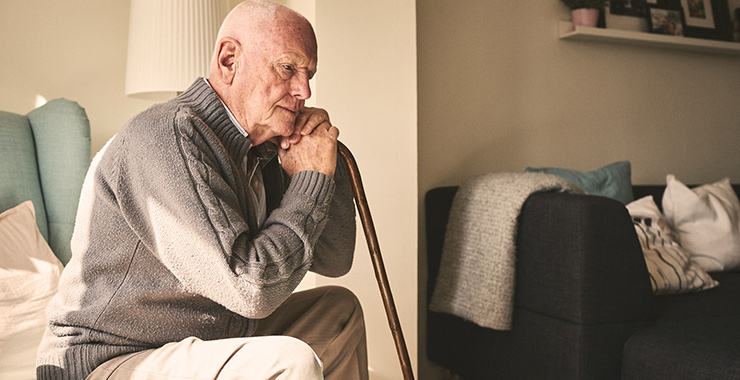
Effects of loneliness and isolation
Equally demonstrated by a review of the effects of perceived social isolation across the life bridge, co-authored by Hawkley, loneliness can wreak havoc on an individual'due south physical, mental and cerebral health ( Philosophical Transactions of the Royal Society B , Vol. 370, No. 1669, 2015 ). Hawkley points to testify linking perceived social isolation with adverse wellness consequences including depression, poor sleep quality, impaired executive function, accelerated cognitive refuse, poor cardiovascular function and dumb immunity at every stage of life. In addition, a 2019 study led past Kassandra Alcaraz, PhD, MPH, a public health researcher with the American Cancer Society, analyzed information from more than than 580,000 adults and found that social isolation increases the adventure of premature death from every crusade for every race ( American Periodical of Epidemiology , Vol. 188, No. one, 2019 ). According to Alcaraz, among black participants, social isolation doubled the risk of early death, while it increased the take chances amongst white participants by 60 to 84 percent.
"Our research really shows that the magnitude of risk presented past social isolation is very like in magnitude to that of obesity, smoking, lack of access to care and physical inactivity," she says. In the written report, investigators weighted several standard measures of social isolation, including marital status, frequency of religious service attendance, gild meetings/grouping activities and number of close friends or relatives. They constitute that overall, race seemed to be a stronger predictor of social isolation than sex activity; white men and women were more likely to be in the to the lowest degree isolated category than were black men and women.
The American Cancer Society study is the largest to date on all races and genders, only previous research has provided glimpses into the harmful furnishings of social isolation and loneliness. A 2016 study led by Newcastle Academy epidemiologist Nicole Valtorta, PhD, for example, linked loneliness to a 30 percentage increase in take chances of stroke or the development of coronary center disease ( Eye , Vol. 102, No. 13 ). Valtorta notes that a lonely private'due south higher risk of ill wellness probable stems from several combined factors: behavioral, biological and psychological.
"Lacking encouragement from family or friends, those who are lone may slide into unhealthy habits," Valtorta says. "In addition, loneliness has been plant to raise levels of stress, impede slumber and, in turn, harm the body. Loneliness can also augment depression or anxiety."
Last year, researchers at the Florida Land University College of Medicine also plant that loneliness is associated with a 40 pct increment in a person'southward risk of dementia (The Journals of Gerontology: Series B, online 2018). Led by Angelina Sutin, PhD, the study examined data on more than 12,000 U.S. adults ages 50 years and older. Participants rated their levels of loneliness and social isolation and completed a cognitive battery every ii years for up to x years.
Amid older adults in item, loneliness is more likely to set in when an individual is dealing with functional limitations and has depression family back up, Hawkley says. Better self-rated health, more than social interaction and less family strain reduce older adults' feelings of loneliness, co-ordinate to a study, led by Hawkley, examining data from more than 2,200 older adults ( Research on Crumbling , Vol. twoscore, No. 4, 2018 ). "Even among those who started out alone, those who were in better health and socialized with others more oftentimes had much better odds of subsequently recovering from their loneliness," she says.
A 2015 written report led by Steven Cole, MD, a professor of medicine at the Academy of California, Los Angeles, provides boosted clues as to why loneliness tin impairment overall health ( PNAS , Vol. 112, No. 49, 2015). He and his colleagues examined gene expressions in leukocytes, white claret cells that play key roles in the immune system'due south response to infection. They found that the leukocytes of lonely participants—both humans and rhesus macaques—showed an increased expression of genes involved in inflammation and a decreased expression of genes involved in antiviral responses.
Loneliness, information technology seems, can lead to long-term "fight-or-flying" stress signaling, which negatively affects immune system functioning. Only put, people who feel lonely have less immunity and more inflammation than people who don't.

Combating loneliness
While the harmful effects of loneliness are well established in the research literature, finding solutions to adjourn chronic loneliness has proven more challenging, says Holt-Lunstad.
Developing effective interventions is not a simple job because in that location's no single underlying cause of loneliness, she says. "Different people may exist lonely for different reasons, then a ane-size-fits-all kind of intervention is not likely to work because you need something that is going to accost the underlying crusade." Rokach notes that efforts to minimize loneliness can start at abode, with pedagogy children that aloneness does not hateful loneliness. As well, he says, schools tin can help foster environments in which children look for, identify and intervene when a peer seems lonely or disconnected from others.
In terms of additional ways to address social isolation and feelings of loneliness, research led by Christopher Masi, Medico, and a team of researchers at the University of Chicago suggests that interventions that focus inwards and accost the negative thoughts underlying loneliness in the first place seem to assistance combat loneliness more than those designed to meliorate social skills, enhance social support or increase opportunities for social interaction (Personality and Social Psychology Review, Vol. 15, No. 3, 2011). The meta-assay reviewed 20 randomized trials of interventions to decrease loneliness in children, adolescents and adults and showed that addressing what the researchers termed maladaptive social cognition through cognitive-behavioral therapy (CBT) worked all-time because information technology empowered patients to recognize and deal with their negative thoughts almost self-worth and how others perceive them, says Hawkley, one of the written report's co-authors.
Nevertheless, some research has found that engaging older adults in community and social groups tin atomic number 82 to positive mental health effects and reduce feelings of loneliness. Last year, Julene Johnson, PhD, a University of California, San Francisco researcher on crumbling, examined how joining a choir might gainsay feelings of loneliness among older adults ( The Journals of Gerontology: Series B , online 2018 ). Half of the study's 12 senior centers were randomly selected for the choir program, which involved weekly ninety-minute choir sessions, including informal public performances. The other one-half of the centers did not participate in choir sessions. After six months, the researchers found no significant differences between the two groups on tests of cognitive part, lower trunk strength and overall psychosocial health. But they did observe pregnant improvements in two components of the psychosocial evaluation among choir participants: This group reported feeling less solitary and indicated they had more than interest in life. Seniors in the not-choir grouping saw no alter in their loneliness, and their interest in life declined slightly.
Researchers at the University of Queensland in Australia have also found that older adults who have part in social groups such equally volume clubs or church groups accept a lower hazard of decease ( BMJ Open , Vol. half dozen, No. 2, 2016 ). Led past psychologist Niklas Steffens, PhD, the team tracked the health of 424 people for vi years after they had retired and found that social group membership had a compounding consequence on quality of life and risk of death. Compared with those still working, every grouping membership lost later retirement was associated with around a x percent driblet in quality of life half dozen years later. In addition, if participants belonged to two groups earlier retirement and kept these upwards over the following six years, their risk of death was 2 percent, rise to 5 percent if they gave up membership in one group and to 12 percent if they gave upwardly membership in both.
"In this regard, practical interventions need to focus on helping retirees to maintain their sense of purpose and belonging by profitable them to connect to groups and communities that are meaningful to them," the authors say.
To that end, cohousing appears to be growing in popularity among young and erstwhile effectually the world as a way to improve social connections and subtract loneliness, among other benefits. Cohousing communities and mixed-age residences are intentionally built to bring older and younger generations together, either in whole neighborhoods inside single-family homes or in larger apartment buildings, where they share dining, laundry and recreational spaces. Neighbors gather for parties, games, movies or other events, and the cohousing slice makes it easy to form clubs, organize child and elder care, and carpool. Hawkley and other psychologists argue that these living situations may also provide an antidote to loneliness, especially among older adults. Although formal evaluations of their effectiveness in reducing loneliness remain scarce, cohousing communities in the United States now number 165 nationwide, according to the Cohousing Association, with another 140 in the planning stages.
"Older adults have get so marginalized and made to feel as though they are no longer productive members of guild, which is alone-making in and of itself," Hawkley says. "For society to be healthy, we have to detect ways to include all segments of the population, and many of these intergenerational housing programs seem to be doing a lot in terms of dispelling myths about former age and helping older individuals feel like they are important and valued members of lodge over again."
Source: https://www.apa.org/monitor/2019/05/ce-corner-isolation
0 Response to "Who Signs Papers on Family Medical Leave Act"
Post a Comment