How Do You Know if Your Lyme Treatment Worked
What is the treatment for Lyme disease?
The kickoff-line standard of care treatment for adults with Lyme affliction is doxycycline, a tetracycline antibiotic. Other antibiotics that have activeness against borrelia include the penicillin-like antibiotic, amoxicillin, and the 2nd generation cephalosporin, Ceftin. The mainstay of treatment is with oral (pill) antibiotics, but intravenous antibiotics are sometimes indicated for more than difficult to treat cases of neurologic-Lyme affliction, such every bit meningitis, and cases of belatedly Lyme arthritis.
Why are antibiotics the offset line of handling for Lyme disease?
The utilise of antibiotics is critical for treating Lyme illness. Without antibiotic treatment, the Lyme affliction causing leaner can evade the host immune system, disseminate through the blood stream, and persist in the torso. Antibiotics go into the bacteria preferentially and either stop the multiplication of the bacteria (doxycycline) or disrupt the cell wall of the bacteria and kill the bacteria (penicillins). By stopping the growth or killing the bacteria the human being host allowed response is given a leg up to eradicate the residue infection. Without antibiotics, the infection in Lyme affliction can evade the host immune system and more readily persist.
What are the side furnishings of Lyme disease treatments?
Antibiotics, like all medications, have the potential for side effects. Any antibody tin crusade peel rashes, and if an itchy red rash develops while on antibiotics, a patient should see their physician. Sometimes symptoms worsen for the showtime few days on an antibiotic. This is called a Herxheimer reaction and occurs when the antibiotics starting time to kill the bacteria. In the first 24 to 48 hours, dead bacterial products stimulate the immune system to release inflammatory cytokines and chemokines that tin can crusade increased fever and achiness. This should exist transient and last no more than a solar day or ii after the initiation of antibiotics.
The virtually common side upshot of the penicillin antibiotics is diarrhea, and occasionally even serious cases caused by the bacteria Clostridium difficile. This bacterial overgrowth condition occurs because antibiotics impale the good bacteria in our gut. It can be helpful to use probiotics to restore the practiced bacteria and microbiome balance.
Prognosis
The prognosis afterwards early treatment of Lyme disease is generally very skillful. The prognosis worsens, even so, when diagnosis and treatment are delayed.
Most patients with early on Lyme illness infection recover with antibiotics and return to their normal state of health. However, some patients suffer from ongoing or recurrent symptoms related to Lyme disease despite standard of care antibiotic therapy. The persistent symptoms in Lyme disease can take a large negative impact on an individual'south health and quality of life. Patients often phone call this condition chronic Lyme affliction, although an agreed upon clinical example definition for chronic Lyme disease has proven difficult to reach a consensus on.
For enquiry studies, a defined subset of this condition is called Post Treatment Lyme Illness (PTLD). This research definition is existence used to investigate the potential causes of persistent symptoms in Lyme disease.
What is Post Treatment Lyme Disease?
Mail service Treatment Lyme Affliction (PTLD) represents a research subset of patients who remain significantly ill vi months or more than post-obit standard antibiotic therapy for Lyme affliction. PTLD is characterized by a constellation of symptoms that includes severe fatigue, musculoskeletal pain, sleep disturbance, low, and cognitive bug such every bit difficulty with short-term retentiveness, speed of thinking, or multi-tasking. In the absence of a direct diagnostic biomarker blood test, PTLD has been difficult to define past physicians, and its existence has been controversial. Withal, our clinical enquiry shows that meticulous patient evaluation when used alongside appropriate diagnostic testing tin reliably identify patients with a history of previously treated Lyme disease who display the typical symptom patterns of PTLD.
Symptoms of Mail Treatment Lyme Illness
- Include severe fatigue, musculoskeletal pain, & cognitive bug
- Tin significantly impact patients' health and quality of life
- Tin can be debilitating and prolonged
Our research indicates the chronic symptom burden related to PTLD is pregnant. Although often invisible to others, the negative impact on quality of life and daily functioning is substantial for PTLD sufferers.
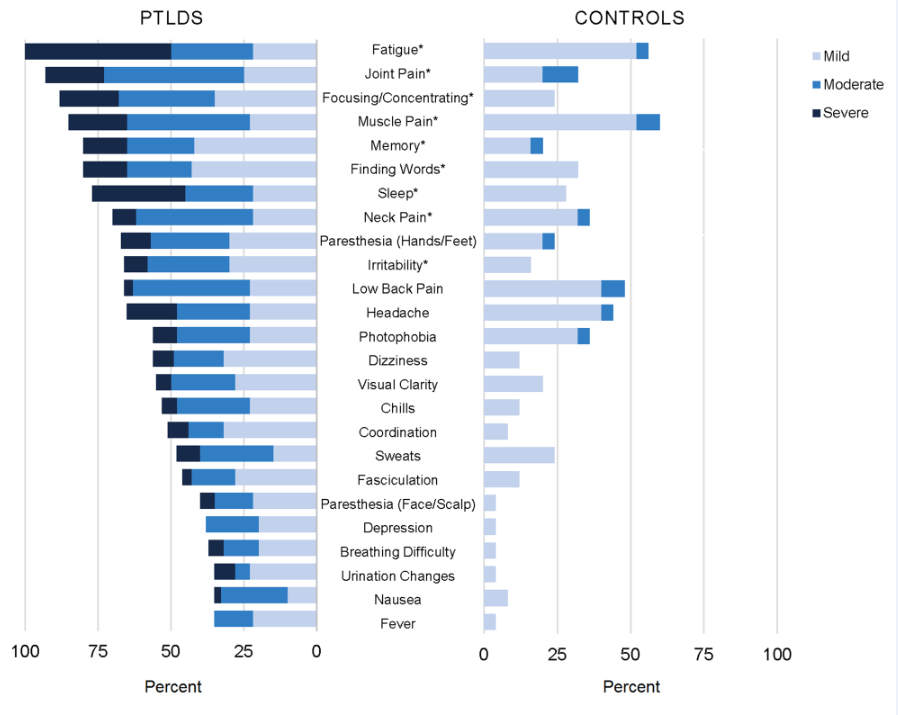
The chronic symptom burden related to Lyme disease is considerable, as shown on the left side of the graph in a higher place, and statistically significantly greater than the aches and pains of daily living experienced by the command group, on the right.
What are the risk factors for Post Treatment Lyme Illness?
Gamble factors for Mail service Treatment Lyme Illness include:
- Delay in diagnosis
- Increased severity of initial illness
- Presence of neurologic symptoms
Increased severity of initial disease, the presence of neurologic symptoms, and initial misdiagnosis increase the chance of Post Handling Lyme Disease. PTLD is especially common in people that have had neurologic involvement. The rates of Postal service Treatment Lyme Affliction afterwards neurologic involvement may be as high as twenty% or even higher. Other chance factors being investigated are genetic predispositions and immunologic variables.
In improver to Borrelia burgdorferi, the bacteria that causes Lyme affliction, there are several other tick-borne co-infections that may also contribute to more than prolonged and complicated illness.
What causes Mail Treatment Lyme Disease?
The causes of PTLD are not yet well understood but tin be multifactorial. Our Center is investigating the potential roles of:
- Infection-induced immune dysfunction or auto-immunity
- Chronic inflammation
- Persistent bacterial infection or bacterial debris
- Neural network amending
- Other tick-borne infections
- Other biologic mechanisms of disease
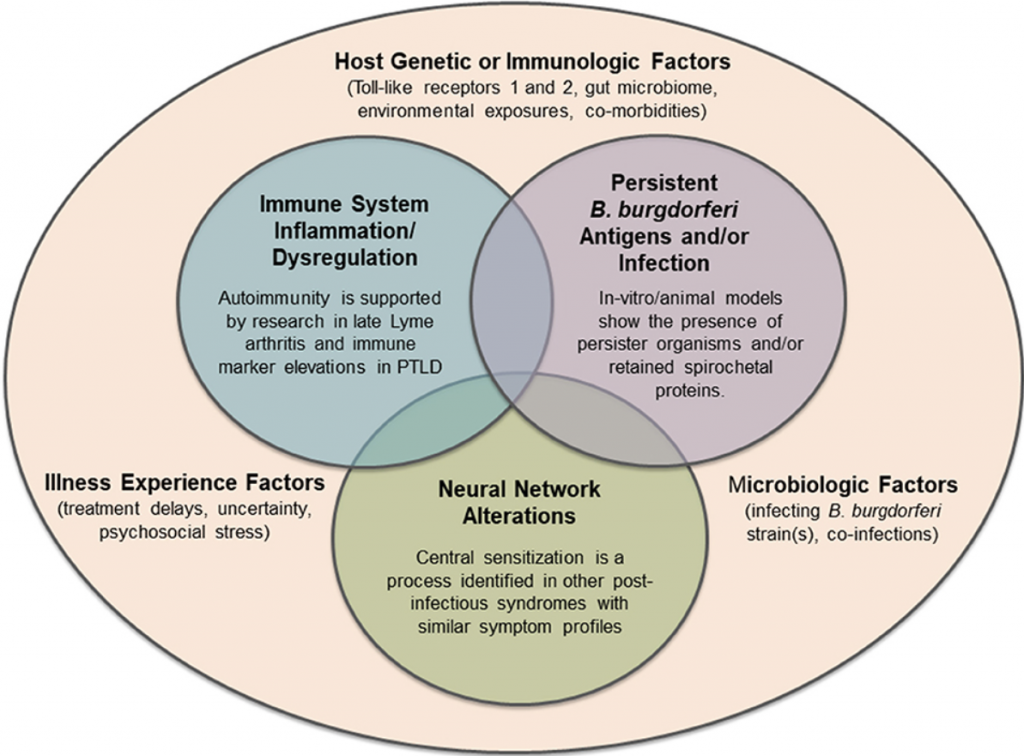
Our enquiry has validated PTLD as a serious and impairing condition. Notwithstanding, the causes of PTLD are non yet well understood or validated, and the term PTLD does not mean post-infection or imply an assumption of underlying biologic mechanisms. The Lyme affliction patient population is heterogeneous and the drivers of persistent disease can be varied and multifactorial. The roles of immune dysfunction, autoimmunity, chronic inflammation, persistent bacterial infection, persistent bacterial antigenic debris, neural network amending, and other potential causative biologic mechanisms of PTLD are being investigated at our Center.
Research at our Middle aims to empathise the biologic drivers of all manifestations of Lyme affliction so that diagnostics tin exist improved, and more effective personalized treatments can be developed to enhance patients' wellness outcomes.
Is there a cure for Post Treatment Lyme Disease?
Currently there are no FDA approved treatments for the persistent symptoms in Lyme affliction. Therefore, treatments must exist individualized by addressing specific findings, symptoms, and circumstances for each individual.
Belatedly Lyme Arthritis
What is the prognosis for Late Lyme Arthritis?
Following antibiotic therapy, approximately 90% of late Lyme arthritis patients recover from extensive joint swelling, arthritis, and pain.
What happens if a patient doesn't recover from Late Lyme Arthritis?
Afterward all-encompassing antibody treatment, approximately 10% of late Lyme arthritis patients remain symptomatic with a status termed antibiotic refractory belatedly Lyme arthritis. All-encompassing research has shown that the bacteria can no longer exist found in the tissue or fluid of this subgroup of patients. However, recent research shows that peptidoglycans, from parts of Borrelia burgdorferi's prison cell wall, tin remain behind in patients' joints and trigger an immune reaction that could be perpetuating the inflammation observed in some Lyme arthritis patients.
Why are patients often referred to the Center?
Lyme disease encompasses a range of biologic processes and disease manifestations. Patients are often referred to the Lyme Disease Enquiry Center for evaluation of chronic Lyme disease, an umbrella term that encompasses many heterogeneous subsets of illness. Examples of defined Lyme disease subsets include Post Treatment Lyme Illness (PTLD), and Antibody Refractory Late Lyme Arthritis. The mechanisms of these Lyme illness conditions are different and effective treatments need to be tailored accordingly.
Persistent symptoms of Lyme disease are similar to and overlap with other conditions involving fatigue, pain, and cerebral symptoms. Therefore, rigorous diagnostic evaluation is necessary to make up one's mind if Lyme illness could exist the trigger for ongoing affliction processes or if another affliction processes are involved.
Gaps in noesis tin lead to problems in clinical care. Past distinguishing research subsets of Lyme affliction, such as PTLD, our patient-centered clinical inquiry plan is illuminating the complex pathophysiology of the illness to ameliorate diagnostics, treatments, and quality of life for patients.
Source: https://www.hopkinslyme.org/lyme-disease/treatment-and-prognosis-of-lyme-disease/
0 Response to "How Do You Know if Your Lyme Treatment Worked"
Post a Comment