Evaluating What Were Three Factors That Contributed to the Baby Boom? Quizlet
The dizzying speed of omicron's spread has left Americans questioning much of what they know about Covid-19.
Though much remains uncertain, experts are beginning to empathize more than about the variant and how it affects people who are vaccinated, unvaccinated or who accept had a Covid infection. For example, people who are exposed to omicron appear to get sick faster and may accept symptoms that are unlike than those of other variants.

What are the symptoms of omicron?
Early evidence suggests that for most people, at least those who are upwards to appointment on their Covid vaccines, omicron appears to cause milder illness that can resemble the mutual cold, another form of the coronavirus.
For total coverage of the coronavirus pandemic
Dr. Katherine Poehling, an infectious affliction specialist and vaccinologist at Atrium Wellness Wake Woods Baptist in North Carolina, said that these announced to be the prominent symptoms from omicron:
- Cough
- Fatigue or tiredness
- Congestion and runny nose
- Sore throat
- Headache
"We're seeing a lot of sore throat, runny nose, fatigue and mild headache," said Dr. Rahul Sharma, the emergency physician-in-chief at the NewYork-Presbyterian/Weill Cornell Medical Center.
Unlike in previous variants, the loss of taste and smell seems to be uncommon, doctors say.
But Poehling, who is as well a member of the Advisory Commission on Immunization Practices, which helps guide the Centers for Disease Control and Prevention's decisions on vaccines, and others stress that those symptoms are based on early reports of omicron cases, not scientific studies.
"Anecdotal reports represent just one person," said Dr. Bruce Y. Lee, a professor of health policy and direction at the City University of New York School of Public Health. "We have to take them with a grain of salt."
What's more, they may only reverberate certain segments of the population: young and otherwise healthy, as well as those who are fully vaccinated.
"It is articulate that if you're vaccinated, particularly if you've had a booster, omicron tends to produce milder infections," said Dr. William Schaffner, an communicable diseases skilful at the Vanderbilt Academy Medical Center in Nashville, Tennessee.
"What we haven't seen yet is a substantial trunk of information about what omicron will practise in unvaccinated people," he added.
Indeed, at least ane person who was not vaccinated is reported to take died of omicron. Officials in Houston announced in December that the unvaccinated man in his 50s succumbed to the virus.
For people who have been vaccinated, but have not had a booster, typical symptoms include more than coughing, more fever and more than fatigue than those who have received an extra dose, said Dr. Craig Spencer, director of global health in emergency medicine at New York-Presbyterian/Columbia University Medical Center.
Does omicron crusade less astringent illness?
There is also emerging evidence that omicron tends not to burrow deep into the lungs every bit much every bit previous variants. A written report, which was posted online past the University of Hong Kong and not all the same peer-reviewed, plant that while omicron is less severe in the lungs, it tin can replicate faster higher upwards in the respiratory tract.
In this way, omicron may deed more like bronchitis than pneumonia, said Dr. Hugh Cassiere, managing director of critical care services for Sandra Atlas Bass Centre Hospital at the North Shore University Hospital, on Long Island, New York.
"Usually patients with acute bronchitis tend not to be curt of breath. They tend to coughing and produce sputum," he said. "Patients with pneumonia tend to be curt of breath and feel more than fatigued than bronchitis in general."
A small study from the CDC plant that people who had Covid and are afterward reinfected with omicron may experience fewer symptoms than they did during their initial bout with the virus.
Still, it's virtually impossible for people to rely on symptoms to self-diagnose an illness. In addition to omicron, the delta variant continues to circulate, along with increasing cases of the influenza.
For these reasons, doctors urge people who have whatsoever cold symptoms or flulike symptoms to get tested.
How quickly do omicron symptoms start?
According to early on data, the time it takes for an infected person to develop symptoms after an exposure may be shorter for omicron than for previous variants — from a total calendar week down to as little as 3 days or less.
While much more than research is needed, it makes scientific sense that a highly contagious virus like the omicron variant would have a shorter incubation period. Its goal, later all, is to infect as many people as possible, as speedily as possible.
"That'southward why the spread is occurring at a much faster pace," said Dr. Anita Gupta, an anesthesiologist and critical care physician at the Johns Hopkins Schoolhouse of Medicine. She added that it's possible the incubation period could be shorter or longer depending on a number of variables, including historic period, underlying wellness problems and vaccination status. "There is no hard and fast rule here."
How long do symptoms last?
Symptoms appear to last iii to five days for most patients, said Sharma.
"A lot of these patients are not having the symptoms for the 10 to 12 days that I saw when there were no vaccinations," he said. He noted that, in full general, symptoms announced to be shorter and milder in the vaccinated compared to the unvaccinated.
For the vaccinated, emergency room or hospital stays are also typically shorter.
"What I can tell you is that patients that are unvaccinated are definitely our sicker patients," Sharma said. "Those are the patients that are more likely to go to the ICU. Those are the patients that are more likely to exist admitted to the hospital."
Dr. Ryan Maves, an infectious diseases and critical care physician at the Wake Forest School of Medicine in Due north Carolina, agreed, saying the overwhelming majority of Covid patients he sees in the ICU are unvaccinated.
When should I go tested for Covid?
Given the potential for a shorter incubation menses, Vanderbilt'due south Schaffner advised that anyone who has been in contact with an infected private get tested virtually 72 hours post-obit the exposure.
"If you've been exposed and now you're asking yourself, 'When should I get tested?' I recall you lot would best await at least three days to run into if yous've turned positive," he said.
For the millions of people without whatsoever known Covid exposure, but who are getting together with friends and family, Schaffner said, it would be prudent to get a rapid test the day of the gathering.
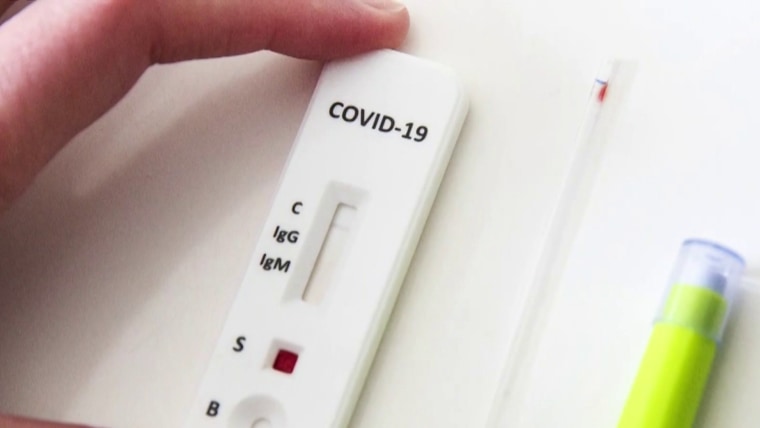
Dr. Anthony Fauci, primary medical adviser to President Joe Biden, agreed.
"By all means, become the extra step, get the extra mile to get tested" to alleviate any concerns nearly gatherings, he said on NBC's "TODAY" show concluding calendar month.
Could omicron lead to long Covid?
Though much remains unknown virtually omicron, experts say the variant could atomic number 82 to long Covid, even with a mild example.
Patients with long-term symptoms can experience crushing fatigue, irregular centre rhythms and other issues months later on their initial Covid infection. This occurred during the first wave of the pandemic, and has continued to lead to long Covid issues through the delta wave.
"We should assume that this variant tin can practise the same thing that previous variants have until proven otherwise," Lee, of CUNY, said.
Previous research, however, suggests that vaccination can greatly reduce the risk for long Covid.
How worried should I exist nigh omicron?
The omicron variant accounts for about 95 pct of U.Southward. samples and the delta variant makes upwards the rest, according to contempo CDC projections.
Since omicron has hit almost every area of the U.Due south., "the question is, how much disease will it cause?" said Dr. Michael Saag, an communicable diseases proficient and acquaintance dean for global health at the University of Alabama at Birmingham.
Experts continue to urge people to get vaccinated and go a booster shot to reduce the gamble of severe affliction.
Follow NBC Health on Twitter & Facebook .
Source: https://www.nbcnews.com/health/health-news/omicron-symptoms-covid-what-to-know-rcna9469
0 Response to "Evaluating What Were Three Factors That Contributed to the Baby Boom? Quizlet"
Post a Comment